
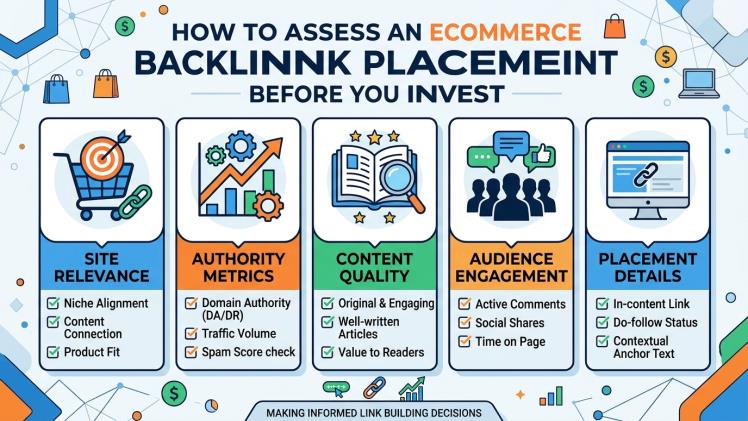
For an online store, a backlink can do more than help a page appear in search results. The right mention may introduce a product to interested readers, support a category page, and build trust in a competitive market. The wrong placement may bring little value—or create a risk if it looks manipulative. Knowing how to assess an ecommerce backlink placement means looking beyond a site’s headline metrics and asking whether the link makes sense for both the reader and your business.
Start with the audience and subject matter
First, consider whether the publishing site reaches people who could reasonably care about your products. A specialist home-improvement blog may be a natural fit for a furniture retailer; a general business publication might be better suited to a software company than a store selling kitchen accessories. Audience fit is not always an exact match, but the connection should be easy to explain.
Review recent articles, not just the site’s homepage or its stated mission. Look for a consistent editorial focus, useful reporting, and evidence that real readers would find the content relevant. A site with a broad subject range can still be credible, but an abrupt mix of unrelated posts may suggest that links are being placed without much editorial judgment.
Examine the page, not only the domain
A respected website can publish a weak page, just as a smaller publication can produce a genuinely useful one. Read the proposed article in full. Does it answer a question, offer original insight, or help readers make a decision? Is the link included in a passage where it adds context, or does it appear awkwardly inserted into generic copy?
Check that the page is accessible, clearly written, and connected to the site’s other content. Look at its publication date and whether the surrounding articles receive updates. A page that exists mainly to hold a link, with little substance or no meaningful editorial context, is unlikely to be a strong long-term placement.
Match the destination to the reader’s next step
For ecommerce, the best destination depends on what the article is discussing. A guide comparing styles may naturally point to a relevant category page. A detailed review of one item may make a product page the most helpful destination. Sending every mention to the homepage can miss an opportunity to provide a direct, useful next step.
Before approving a placement, open the proposed destination on both desktop and mobile. Confirm that it loads, represents the product or category described, and gives visitors clear information. Consider stock availability, shipping details, product specifications, and whether the page is likely to remain relevant. A link that attracts qualified visitors but leads to a confusing or unavailable product page can undermine the value of the referral.
Evaluate credibility and link context
Domain scores and estimated traffic can help with an initial review, but they are not proof of quality. Metrics differ between tools and can be inflated. Look instead for a combination of signals: genuine topical coverage, an identifiable editorial process, useful content, and a natural pattern of references. Search the site’s archive for repeated thin articles or large numbers of unrelated commercial links.
Then consider how the link is presented. The surrounding sentence should explain why the destination is relevant. Anchor text should read naturally rather than forcing an exact search phrase into the article. Ask whether the placement would still make sense if search engines did not exist. If it would help a reader discover a useful product or resource, that is a stronger sign than a link added solely to manipulate rankings.
It also helps to understand the broader strategy behind links to product and category pages. This guide to ecommerce link building discusses how those destinations can fit into a deliberate backlink plan. Use that kind of guidance as a starting point, then judge each proposed placement on its own merits.
Consider the work, cost, and measurement
Set a clear purpose before paying for content or outreach. A placement might aim to reach a niche audience, earn referral visits, support a new category, or strengthen brand recognition. These goals shape what success looks like. Track referral traffic and engagement alongside search visibility, and allow time for results to develop. One link rarely provides a reliable basis for judging an entire strategy.
Marketing teams with limited resources may also need help producing research, writing, or outreach materials. For people exploring digital marketing for startups, Osdire’s overview of freelance digital marketing explains common roles and ways this work is organized. Whether a business handles campaigns internally or hires outside support, it should agree on the deliverable, review process, timeline, and budget before work begins.
A practical review before approval
- Relevance: Does the site and article make sense for the intended audience?
- Editorial value: Would the page be useful even without the backlink?
- Destination: Does the linked product or category page meet the reader’s likely needs?
- Context: Is the link placed naturally, with clear and accurate anchor text?
- Durability: Is the site likely to maintain the article and link responsibly?
- Measurement: Is there a realistic way to assess traffic, engagement, or other campaign goals?
A careful review cannot guarantee rankings or sales, but it can help separate useful editorial opportunities from placements that merely look impressive in a report. Prioritize relevance, reader experience, and a destination that fulfills the promise of the article. Over time, those standards make an ecommerce backlink program more coherent—and easier to evaluate honestly.