How to Buy a Solar Water Heater in Nepal: ETC vs FPC, Sizing, and 9 Questions to Ask Before You Pay

Most people buying a solar water heater in Nepal are buying their first one, and they will not buy another for fifteen years. That is an uncomfortable position to be in because you make the decision exactly once, with no experience, and you live with it for a long time.
The good news is that the technology is mature and the decisions are few. There are really only four things to get right such as collector type, size, pressure configuration, and installer — and this guide covers all four.
First, understand what you are actually buying
A solar water heater is three components and a frame. Suppliers quote you a single price, which makes it hard to tell a good system from a bad one. Separate the parts and it gets much easier.
The collector
This is the part that captures sunlight. It is either a row of glass evacuated tubes (ETC) or a flat glazed panel with copper pipework inside (FPC). The collector determines how much heat you get on a cold or overcast morning.
The storage tank
This is where the heat lives until you use it. What matters is the inner tank material which is stainless steel grade, or glass-lined steel and the thickness of the insulation. Insulation is where cheap systems cut corners, because you cannot see it. A poorly insulated tank loses most of the day’s collection overnight, which means you get cold water at 6am in January despite a sunny yesterday.
The circulation method
Most household systems in Nepal are thermosiphon: hot water rises naturally from the collector into the tank with no pump and no electricity. Simple, reliable, nothing to break. The trade-off is that the tank must sit above the collector, which is why these systems look the way they do on rooftops.
Forced-circulation systems use a small pump and allow the tank to sit elsewhere. They are more flexible, more efficient in some layouts, and have a component that can fail. For most houses, a thermosiphon is the right answer.
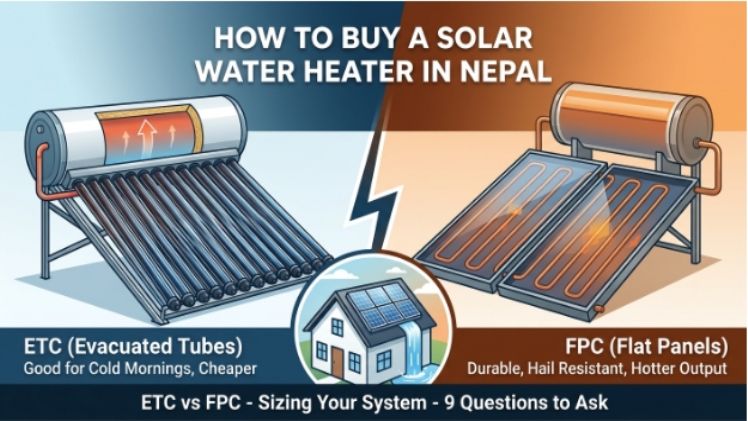
ETC vs FPC: Which suits Nepali conditions?
This is the question every buyer asks and most suppliers answer with whatever they stock.
Where does ETC win?
Evacuated tubes are vacuum-insulated, so they lose very little heat to cold air. In a Kathmandu January morning — clear sky, air temperature near 3°C — an ETC system will noticeably outperform a flat plate. They are also cheaper per litre of capacity, and a single broken tube can be replaced individually for a small cost without touching the rest of the system.
For most households in the Valley and at higher altitudes, ETC is the sensible default.
Where FPC wins
Flat plate collectors, particularly all-copper ones, are physically tougher. They survive hail that would crack glass tubes, which matters in areas that get serious pre-monsoon hailstorms. They handle hard water better in some designs, and they are generally more durable over a very long life. They cost more upfront and lose more heat on cold mornings.
If you are in a hail-prone area, or installing on a building where roof access for repairs is difficult, FPC deserves serious consideration.
Sizing: How many litres do you need?
Sizing is where most systems go wrong, and it goes wrong in one direction: too big, because bigger systems cost more and suppliers sell what they quote.
The quick sizing guide
| Household | Typical daily hot water need | Suggested system |
| 2 people | 50–80 litres | 100 LPD |
| 3–4 people | 100–150 litres | 150–200 LPD |
| 5–6 people | 150–220 litres | 200–250 LPD |
| 7+ people | 220+ litres | 300 LPD or two systems |
LPD means litres per day, and it refers to the tank capacity, not the total hot water the system produces. On a good day a system delivers roughly its rated capacity at usable temperature.
Why is oversizing not “safer”?
An oversized system heats a large volume of water to a lower temperature, because the collector area is matched to the tank. You end up with 300 litres of lukewarm water instead of 150 litres of genuinely hot water — and you paid more for the privilege. Size to your actual use, not to your worst imaginable day.
If your household size genuinely varies (guests during Dashain, students home from abroad), plan for the normal case and let the backup element handle the exceptions.
Pressurized or non-pressurized?
This one depends on your plumbing, and getting it wrong is expensive.
Non-pressurized systems work on gravity, fed from an overhead tank. Water pressure at the tap is whatever the height difference gives you. This is the standard configuration in most Nepali homes and it works fine with bucket bathing and normal taps.
Pressurized systems are built to withstand mains or pump pressure. You need one if you have a pressure pump, if you want a proper shower with decent flow, or if you have mixer taps that need balanced hot and cold pressure.
Putting a non-pressurized tank on a pressurized line will destroy it. Ask your installer to confirm in writing which type they are supplying and that it matches your plumbing.
The 9 questions to ask before you pay
Take these to every supplier. The answers will separate the professionals from the rest quickly.
- What is the inner tank made of, and what grade?
“Stainless steel” is not an answer. SS 304 and SS 316 behave differently in hard water. - How thick is the insulation, and what material?
You want a specific number in millimeters, and PUF rather than thin foam. - What standard is the collector tested to?
ISO 9806 is the international standard for collector thermal performance. If nobody can answer, you are buying on faith. - What exactly does the warranty cover, and for how long?
Tank, tubes, frame and element usually have different terms. Get it in writing, with the supplier’s stamp. - Is the backup electric element included, and what rating?
- What is the frame made of, and how is it anchored to the roof?
Galvanized steel, properly fixed. A frame that rusts through in five years takes the system with it. - Will you insulate the pipe runs, and with what?
Uninsulated pipe between roof and bathroom is the most common cause of disappointing performance in Nepal. - What maintenance does this need, and do you provide it?
Ask about annual flushing, descaling and anode rod replacement specifically. - What happens if a tube breaks in year three?
You want a named spare parts availability commitment, not a shrug.
Compare specifications across several suppliers before you commit — retailers like Sewas Mart list system capacities and configurations openly, which makes it easier to check whether a quote you have been given is actually competitive on specification rather than just on price.
Red flags
Walk away if you see any of these:
- A quote with a single line item and no breakdown
- A supplier who sizes your system without asking how many people live in your house
- Warranty terms offered verbally only
- No mention of maintenance at any point in the conversation
- A price dramatically below everyone else’s, which usually means thin insulation, a low-grade tank, or no installation included
- Pressure to decide today because “this price is only until evening”
What proper installation should include?
The installation is half the product. It should cover:
- A structural check that the roof can carry the loaded weight — a 200-litre system full of water plus frame is well over 250 kg concentrated on a few feet
- Correct orientation, facing roughly south, with a tilt suited to Kathmandu’s latitude and biased slightly toward winter performance
- A shading survey across the full day, accounting for water tanks, stairwell blocks and neighboring buildings that may grow taller
- Insulated hot water pipe runs, the shorter the better
- An accessible drain valve, because you will need to flush the tank
- A demonstration of how to operate the backup element, and how to shut the system down if you leave for a month
The maintenance you are signing up for
Nobody mentions this at the point of sale, so understand it before you buy. A solar water heater is low maintenance, not no maintenance, and in the Kathmandu Valley the water itself is the main reason.
Scaling
Valley groundwater is hard. Calcium and magnesium precipitate out when water is heated and build a chalky layer inside the tank and tubes. That layer insulates the very surfaces you need to transfer heat, so a scaled system quietly loses output year after year until someone notices it is no longer performing.
The fix is a flush and descale every one to two years, more often if you are on a borewell rather than a municipal supply. It is a straightforward service job. Ask your supplier what it costs before you buy, not after.
The anode rod
Most glass-lined steel tanks contain a sacrificial magnesium anode rod. Its entire purpose is to corrode so the tank does not. Once it is consumed, corrosion moves on to the tank itself.
Checking and replacing this rod, usually somewhere between year three and year five, is the single cheapest thing you can do to extend the tank’s life. It is also the maintenance item most commonly skipped, which is why some tanks fail at year seven and others are fine at year fifteen.
Annual visual check
Before each cold season: clean the glass, look for a cracked tube, check the frame anchors for rust, and confirm pipe insulation is still intact and has not been chewed by rodents or degraded by UV. Fifteen minutes on the roof in October saves you a cold January.
Conclusion
A solar water heater is one of the few home purchases where the cheapest option and the best option are almost never the same, and where the gap shows up years later rather than on day one. Spend an extra week asking the nine questions above. The system you install this month is the one you will be living with in 2040.